Why Your Website Looks Different on Mobile vs Desktop — Explained
May 6, 2026
Google Fonts and Layout Shift: How to Fix It on WordPress (and Stay GDPR-Friendly)
September 8, 2026The conversation about artificial intelligence in business has a problem: it is almost entirely dominated by stories about large enterprises with dedicated AI teams, seven-figure technology budgets, and the luxury of experimental timelines. If you run a small or medium-sized business, reading this coverage can feel as though AI is something happening in a world that is not yours yet. That impression is wrong — and it is costing businesses that hold it a head start they will not easily recover.
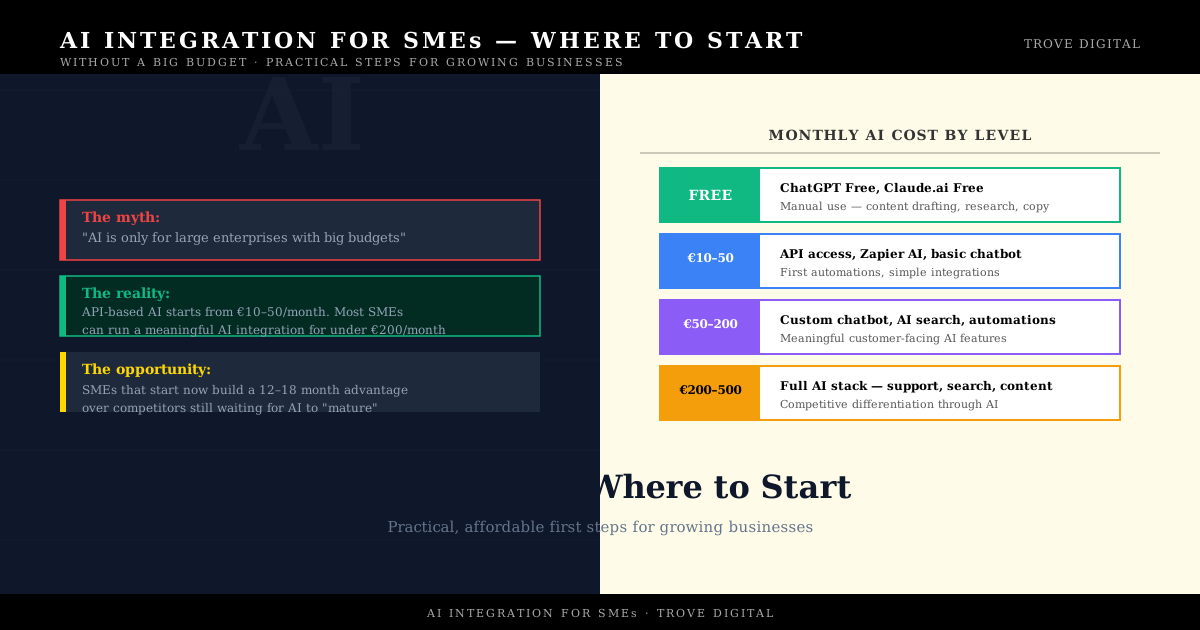
The practical reality is that the most impactful AI tools available to businesses right now are accessible through subscription APIs that cost between zero and two hundred euros per month. The question for most SMEs is not whether they can afford AI integration — it is which integration to start with, and how to approach it without wasting time or money on something that does not fit where the business actually is.
This guide answers those questions directly: what AI can realistically do for an SME on a modest budget, which starting points deliver the fastest return, how to build capability in phases rather than trying to do everything at once, and what tools require no coding knowledge to implement today.
The SME Advantage Nobody Talks About
Large organisations face a significant structural challenge with AI adoption: they have legacy systems, slow procurement processes, IT governance frameworks, and change management complexity that makes even a straightforward AI integration a multi-month project involving multiple departments. An SME with the right motivation can move from decision to deployed chatbot in a week.
Speed of implementation is a genuine competitive advantage at this moment in AI’s development. McKinsey’s State of AI research consistently shows that early AI adopters in any sector create measurable performance gaps over non-adopters that compound over time. The SMEs starting AI integration now — even at the simplest level — are building twelve to eighteen months of operational advantage over competitors who are still waiting for the technology to “mature.”
The technology is already mature enough. The businesses winning with AI are not waiting for a perfect moment — they are starting with a specific, well-defined use case, learning from it, and expanding from there. That is the approach this guide is built around.
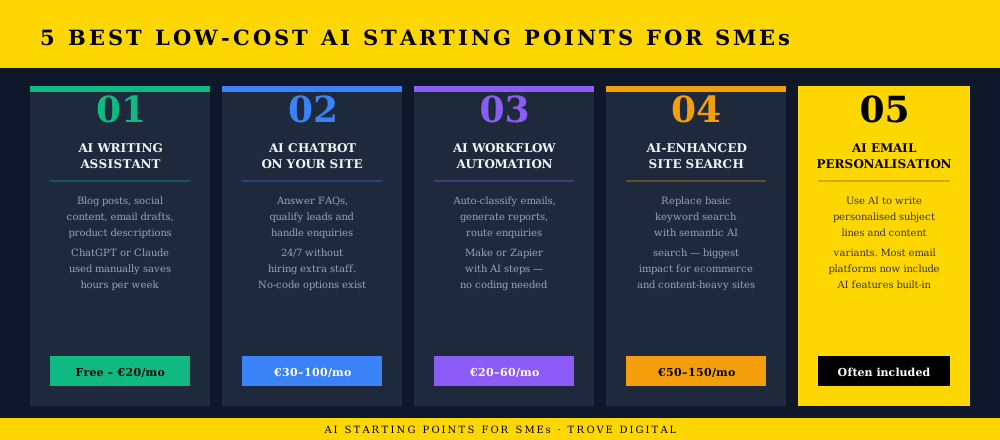
Where to Start: The Five Best Low-Cost AI Entry Points for SMEs
1. AI writing and content assistance
The lowest-friction, highest-immediate-value AI tool for most SMEs is a general-purpose language model used directly — ChatGPT or Claude used in a browser, without any technical integration at all. Using these tools to draft blog posts, write social media captions, generate email copy, create product descriptions, summarise documents, or research competitors costs between nothing and €20 per month for a premium plan.
The time saving is immediate and measurable. A blog post that takes three hours to research and write from scratch takes forty-five minutes when an AI handles the initial draft and the writer focuses on editing, fact-checking, and adding original perspective. A social media manager producing content for five platforms saves several hours per week. An owner-operator answering the same customer email questions repeatedly can create AI-assisted template responses in minutes.
This is not the most sophisticated AI use case — but it is the one that builds the habits, the confidence, and the day-to-day familiarity with AI tools that make everything else easier. Start here, even if you plan to go further.
2. AI chatbot on your website
A website chatbot powered by AI — capable of answering questions in natural language, qualifying leads, and handling common customer enquiries around the clock — is the integration with the most visible customer-facing impact for the lowest build effort. No-code platforms like Tidio and Intercom allow you to deploy an AI-powered chat interface on your website within hours, without writing a line of code, for between zero and €50 per month.
The business case is straightforward. A chatbot trained on your FAQs, product information, and pricing handles enquiries outside business hours, responds instantly rather than making visitors wait for a reply, and qualifies which conversations are genuinely worth a human follow-up. For service businesses that receive a high volume of similar enquiries — consultancies, agencies, ecommerce stores, clinics — the reduction in time spent on routine communication is significant from the first week of deployment.
The key to a useful chatbot is the quality of the information you give it. A chatbot trained on a thorough FAQ document and clear product descriptions will answer questions accurately. One given minimal information will produce vague, unhelpful responses that frustrate visitors. Invest the time in preparing good source material before deployment.
3. Workflow automation with AI
Automation tools like Make (formerly Integromat) and Zapier now include AI steps that can be inserted into workflow automations without writing code. This means you can build processes that take data from one system, send it to an AI for processing — classification, summarisation, drafting — and then route the output to another system, all automatically.
Practical examples: a new enquiry arriving by email is automatically classified by topic and urgency, summarised in one sentence, and routed to the right team member with a suggested response draft. A completed customer order triggers an AI-generated personalised follow-up email. A new blog post is automatically summarised into three social media captions ready for review. A customer review is analysed for sentiment and priority-flagged if it indicates a serious issue.
Each of these automations can be built in Make or Zapier in an afternoon by someone with no coding experience. The free or entry-level tiers cover the needs of most small businesses getting started.
4. AI-enhanced site search
If your website has a search function — particularly if you run an ecommerce store or a content-heavy site — upgrading to AI-powered semantic search is one of the highest-ROI integrations available. Standard keyword search returns poor results when visitors use different language than your content. AI semantic search understands meaning rather than just matching words, returning relevant results even when the exact terms do not appear in your content.
For ecommerce specifically, poor search is a direct conversion problem. A visitor who cannot find what they are looking for leaves. Algolia provides AI-powered search for websites and ecommerce platforms with a free tier that covers up to ten thousand search requests per month — sufficient for many small stores to evaluate the impact before committing to a paid plan.
5. AI in your email marketing platform
Most major email marketing platforms — Mailchimp, Klaviyo, ActiveCampaign — now include AI features at no additional cost. AI-suggested subject lines, send-time optimisation, content generation within the email builder, and predictive segmentation are increasingly standard features rather than premium add-ons. If you are already paying for an email marketing platform, you may already have AI features available that you have not yet switched on.
The Three-Phase SME AI Roadmap
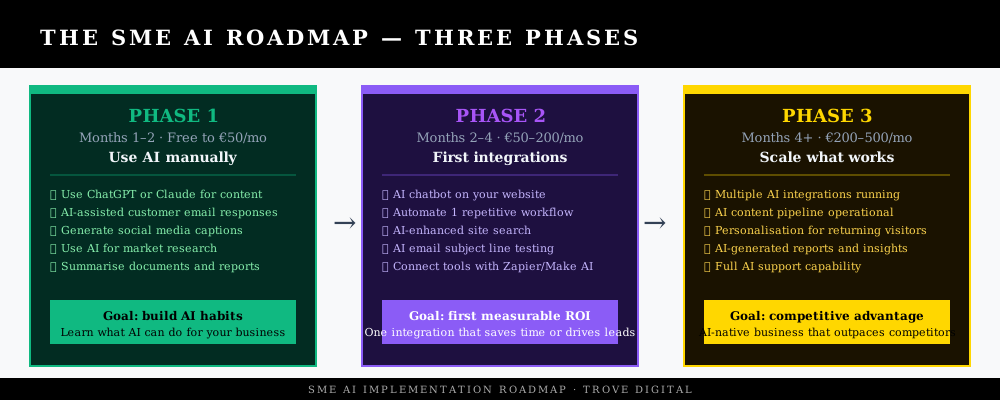
The businesses that get the most from AI are those that build capability progressively rather than trying to implement everything simultaneously. A three-phase approach structures this progression in a way that keeps costs manageable and ensures each phase builds on demonstrated value from the previous one.
Phase 1: Use AI manually (Months 1–2, free to €50/month)
Before integrating AI into your systems, use it as a daily tool. The goal of this phase is not to build anything — it is to develop the team’s familiarity with what AI can and cannot do, identify the specific tasks in your business where AI saves the most time, and build the habits that make subsequent integration more effective.
Use ChatGPT or Claude for content drafts, research, and email writing. Use AI to summarise long documents or reports. Use it to generate first drafts of proposals, job ads, or social posts. The purpose is learning, not deployment — and the cost is effectively zero.
Phase 2: First integrations (Months 2–4, €50–200/month)
With a clear sense of where AI adds value in your specific business, choose one integration to build and deploy properly. For most SMEs, this is either an AI chatbot on the website or an automated workflow that handles a high-volume, repetitive task.
The selection criterion for your first integration is simple: what single task, if automated or AI-assisted, would save the most staff time or produce the most direct commercial impact? Start there. Do not try to deploy three integrations at once. Build one, measure it, understand what works and what does not, and use those learnings to plan the next.
Phase 3: Scale what works (Month 4+, €200–500/month)
Once your first integration is delivering measurable value, the expansion path becomes clear from the evidence. If the chatbot is reducing inbound enquiry volume, the next step might be connecting it to your CRM so it can retrieve customer account information. If the content automation is working, the next step might be building a full content pipeline that takes a topic brief through research, drafting, and social adaptation automatically.
At this phase, most SMEs benefit from working with a digital agency that can advise on more complex API integrations and custom implementations — particularly for integrations that need to connect to proprietary internal systems or that require GDPR-compliant data handling. The Trove Digital team works with SMEs at exactly this stage, helping businesses move from no-code experimentation to properly integrated AI that connects to their existing websites and software.
No-Code AI Tools Every SME Should Know
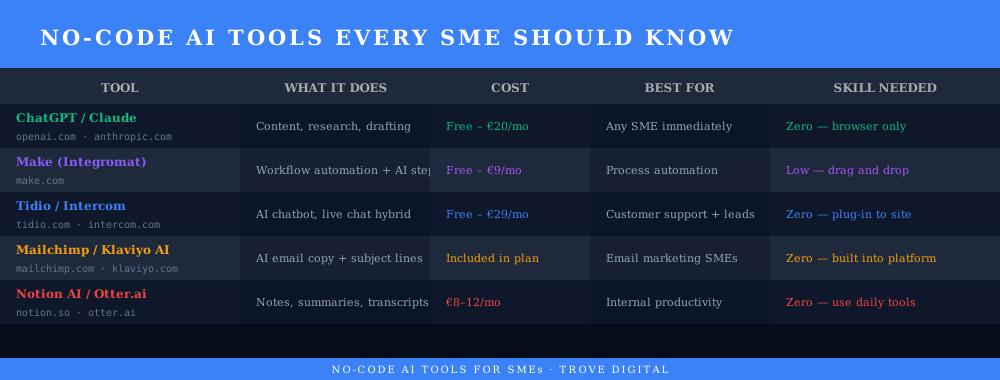
The no-code AI tool landscape has matured significantly. Most of the integrations described in this guide can be built without a developer, using the following tools:
Make (make.com) — the most flexible no-code automation platform, with native AI steps using OpenAI and other providers. Free tier covers most SME use cases for getting started. The visual interface allows you to build complex AI-powered workflows by connecting building blocks — no programming required.
Zapier (zapier.com) — similar to Make, with a more beginner-friendly interface and a large library of pre-built templates. Includes OpenAI integration for adding AI steps to any automation. Free tier is more limited than Make’s but sufficient for simple AI automations.
Tidio (tidio.com) — a customer support platform with AI chatbot capability that can be embedded on any website in minutes. The free tier includes an AI chatbot with a monthly message limit that is generous enough for small sites. Paid plans from €29 per month unlock higher volumes and more customisation.
Notion AI (notion.so) — if your team uses Notion for documentation or project management, the built-in AI features (available from €8 per month per user) can summarise, generate, and transform content directly within your workspace. Zero additional setup required.
Otter.ai (otter.ai) — real-time meeting transcription and AI-generated summaries. Connects to Zoom, Google Meet, and Microsoft Teams. Free tier covers 300 minutes of transcription per month — sufficient for many SMEs to evaluate before committing to a paid plan.
What to Avoid When Getting Started
Most AI implementation failures at the SME level come from the same few mistakes. Understanding them before you start saves time and money.
Starting without a defined use case. “We want to add AI to our business” is not a use case. “We want to reduce the time spent answering the same ten customer questions by email” is a use case. The more specific the problem you are trying to solve, the more likely your first integration is to deliver clear, measurable value.
Trying to do too much at once. An SME that attempts to implement a chatbot, workflow automation, AI search, and personalisation simultaneously will typically deliver all of them poorly. Pick one, do it well, learn from it, and expand. Sequencing matters.
Ignoring GDPR. Any AI tool that processes personal data about your customers — including conversation logs from a chatbot, email address data used for personalisation, or customer behaviour data used for recommendations — must be handled in compliance with GDPR. Check that any tool you use has a GDPR-compliant data processing agreement, understand what data it collects and where it is stored, and update your privacy policy accordingly. This is not optional, but it is also not complicated — most reputable AI platforms have clear GDPR documentation available.
Expecting AI to replace human judgment entirely. AI tools perform best as augmentation — handling the high-volume, repetitive, structured parts of a task so that humans can focus on the judgment-intensive, relationship-oriented, and strategic parts. A business that deploys an AI chatbot and removes all human escalation paths will produce poor customer experiences. One that deploys a chatbot to handle routine enquiries and escalates complex ones to a human agent will produce excellent ones.
Not measuring the impact. Before deploying any AI integration, establish the baseline metric you are trying to improve — time spent on a task, enquiry response time, email open rate, search-to-purchase conversion. Measure it before and after. Without measurement, you cannot distinguish integrations that are working from ones that are not.
GDPR and Data Privacy: What SMEs Need to Know
GDPR applies to virtually every Irish and EU business using AI tools that process personal data. The key practical obligations are: ensure the AI platform you are using has a Data Processing Agreement (DPA) that is GDPR-compliant; understand whether your data is being used to train AI models (most major providers allow you to opt out); confirm that data is processed and stored within the EU or EEA where required; and disclose AI use clearly in your privacy policy.
The Data Protection Commission has published guidance on the use of AI in business that is worth reading before deploying any customer-facing AI integration. The key principle is transparency: customers interacting with an AI system should know they are doing so, and their data should be handled with the same care as any other personal data your business processes.
Summary
AI integration for SMEs does not require a large budget, a technical team, or months of development time. The most impactful starting points — AI writing assistance, website chatbots, workflow automation, enhanced search, and AI-powered email — are accessible through no-code tools at costs that start from zero and rarely exceed €200 per month at the SME scale.
The businesses that will look back at this period as a defining competitive moment are the ones that start now with a specific, well-defined use case, measure the impact, and build from there. The three-phase roadmap — manual use, first integrations, scaled capability — provides a practical structure for doing this without overextending budget or team capacity.
If you are ready to move beyond manual AI use and want to build your first proper integration — a chatbot connected to your website, an automated workflow, or AI-enhanced search — the Trove Digital team can help you scope, build and deploy it. Get in touch to discuss where to start for your specific business.